Abstract-
In detonation, the coupling between fluid dynamics and chemical energy release
is critical. The reaction rate behind the shock front is extremely sensitive to
temperature perturbations and, as a result, detonation waves in gases are always
unstable. A broad spectrum of behavior has been reported for which no
comprehensive theory has been developed. The problem is extremely challenging
due to the nonlinearity of the chemistry-fluid mechanics coupling and
extraordinary range of length and time scales exhibited in these flows. Past
work has shown that the strength of the leading shock front oscillates and
secondary shock waves propagate transversely to the main front. A key
unresolved issue has emerged from the past 50 years of research on this problem:
What is the precise nature of the flow within the reaction zone and how do the
instabilities of the shock front influence the combustion mechanism?
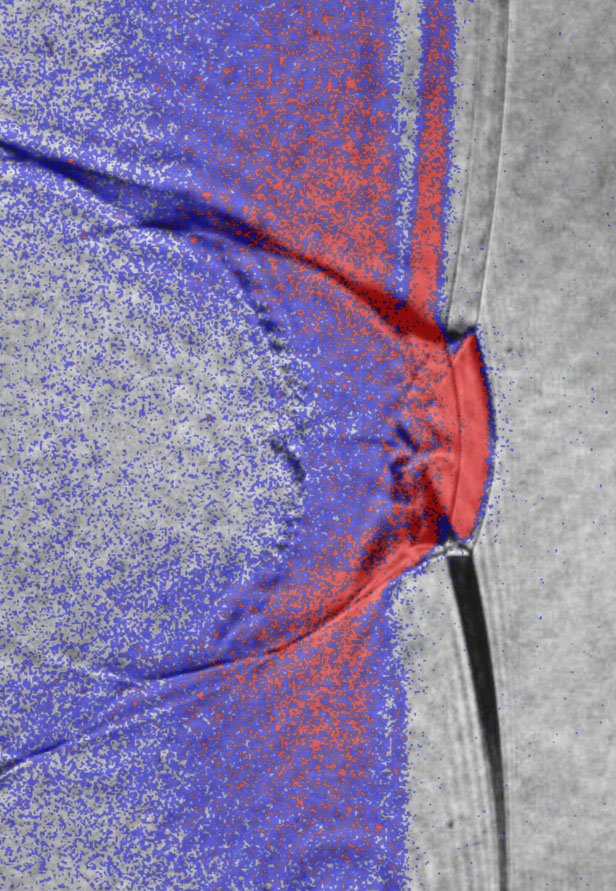
This issue has been examined through dynamic experimentation in two facilities. Key diagnostic tools include unique visualizations of superimposed shock and reaction fronts, as well as short but informative high-speed movies. We study a range of fuel-oxidizer systems, including hydrocarbons, and broadly categorize these mixtures by considering the hydrodynamic stability of the reaction zone. From these observations and calculations, we show that transverse shock waves do not essentially alter the classic detonation structure of Zeldovich-von Neumann-Doring (ZND) in marginally stable detonations, there is one length scale in the instability, and the combustion mechanism is simply shock-induced chemical-thermal explosion behind a piecewise-smooth leading shock front. In contrast, we observe that highly unstable detonations have substantially different behavior involving large excursions in the lead shock strength, a rough leading shock front, and localized explosions within the reaction zone. The critical decay rate model of Eckett and Shepherd (JFM 2000) is combined with experimental observations to show that one essential difference in highly unstable waves is that the shock and reaction front may decouple locally. It is not clear how the ZND model can be effectively applied in highly unstable waves. There is a spectrum of length scales and it may be possible that a type of "turbulent" combustion occurs. We consider how the coupling between chemistry and fluid dynamics can produce a large range of length scales and how possible combustion regimes within the front may be bounded.
 GALCIT Home Page
|
|