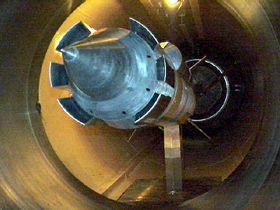
Abstract-
Twenty-five years ago, Dean Chapman of NASA Ames predicted by the year 2000 the United States wind tunnel capabilities would be made obsolete by the use of numerical simulation on high-powered digital computers -- wind tunnels will be employed to store computer outputs. This prediction has not materialized, principally because of the inability to model and predict the complex physical phenomena associated with the occurrence of transition to turbulence, the unsteady and chaotic nature of turbulent transport, shock interaction and compressibility effects on the complexity of real gas and combustion phenomena in high speed transitional and turbulent flows. Today, there remains no clear avenue for the detailed design of high- speed vehicles under practical flight conditions without ground tests. Because information from experimental studies performed at poorly duplicated conditions are as useless as numerical computations with inaccurate models of turbulence and air chemistry and combustion, ground testing should be focused on full-scale testing at fully duplicated flow conditions. Key phenomena such as shock/shock and shock/boundary layer interaction, real gas effects, and turbulent mixing and combustion will be discussed in the context of experimental work for code validation and ground testing of high-speed interceptors and air-breathing vehicles. The experimental research in the areas of scramjet performance, hypervelocity reentry vehicles, and high-speed interceptors will be reviewed. The talk will be concluded with a discussion of wind tunnel training of Olympic athletes in downhill, ski jumping, luge, and skating competition.

 GALCIT Home Page
|
|