Non-Premixed Jet Flame Instabilities: From Hydrodynamic to Thermo-diffusive
Modes
Paul Papas
Fluid Mechanics Laboratory
Swiss Federal Institute of Technology (EPFL)
1015 Lausanne; Switzerland
Abstract-
An overview of recent experimental and theoretical investigations
into instabilities of diffusion flames will be presented. The
importance of the shear-driven Kelvin-Helmholtz instability in jet flames
has long been known. Other types of instabilities, such as thermo-diffusive
modes, which dominate near the dynamic extinction limit of non-premixed
jet flames are less well-known and have only recently become the subject
of theoretical and experimental investigation. As an introduction,
the influence of the heat release and position of a non-premixed flame
on the characteristics of the Kelvin-Helmholtz instabilities will be
discussed and elucidated with experimental spatial growthrate and phase
speed data measured in the linear region. Next, comprehensive studies
will be reviewed which focus on two self-excited, thermo-diffusive instabilities
that occur near extinction conditions: (i) a recently discovered 'pulsation'
or low-frequency oscillation and (ii) cellular instabilities. First,
systematic experiments will be presented which elucidate the conditions for
which (i) regular axisymmetric 'pulsations' of the anchoring base of diluted
propane and methane jet diffusion flames are observed. While a
similar phenomenon had been observed in microgravity flame experiments,
this phenomenon had not been previously reported for gaseous non-premixed
flames in Earth gravity. Additional experiments will be presented
which investigate the formation of (ii) cellular instabilities in non-premixed
jet flames. The key experimental parameters governing both types of
thermo-diffusive instabilities, which are only observed near the extinction
limit, include the reactant Lewis numbers (typically >1 for 'pulsations',
and <1 for 'cells'), the initial mixture strength, and the velocity difference
between the reactant streams. In the second part of the seminar, recent
theoretical efforts to understand the stability of laminar non-premixed
flames in shear layers, both two-dimensional and axisymmetric, will be
described. In addition to the Kelvin-Helmholtz or vorticity modes,
the linear stability model predicts a variety of instabilities near the
extinction state, such as traveling and stationary cellular modes as well
as zero wavenumber instabilities or 'pulsations,' offering connections
with experimental observations.
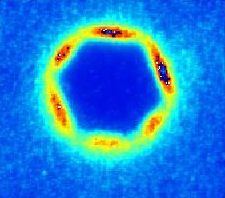
Cellular instability of a non-premixed 21% methane
(79% SF6)-oxygen jet flame near extinction
|
Hexagonal cellular flame instability which forms
in a 21 volume % methane (79% SF6) jet diffusion flame
burning in pure oxygen near extinction (ReD
=100). The left and right images represent the side and top views,
respectively.
|
|
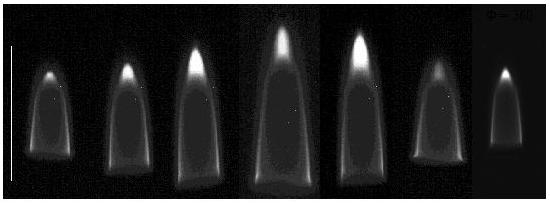
Image sequence of a self-excited, oscillating non-premixed
12% propane (88% nitrogen)-air jet flame near extinction
(see Proc. Comb. Inst., Vol. 28, 2000).
|
Phase-locked images of a 12 volume % propane (88%
nitrogen) jet diffusion flame burning in air near the extinction
limit (Re D =100). The phase
angles (0, 60, 120, ... 360 degrees) cover one period of 570 ms. The
oscillations are self-excited and a very weak loudspeaker excitation was
used here only as a synchronizing signal. The vertical line to
the left indicates a distance of 40 mm from the jet exit.
|
Maintained by: Michael Johnson
EMail: Michael
Johnson
Last modified: September 10, 2002

 GALCIT Home Page