Abstract-
High molecular-weight, linear-chain polymers, added in
dilute solution to turbulent flow, provide one of the oldest and most effective
means of suppression of turbulence. Drag reductions of up to 80% can be readily
obtained with the addition of only a few weight parts per million (wppm) of the
'right' polymer to the working fluid. While the phenomenon of polymer drag
reduction has been known for over fifty years (Toms, 1949), the mechanisms of
drag reduction by dilute polymer solutions are still not well understood and a
general theory which can predict the magnitude of drag reduction in a given
polymer/solvent system or select the `optimal' polymer for a given turbulent
flow is not yet at hand.
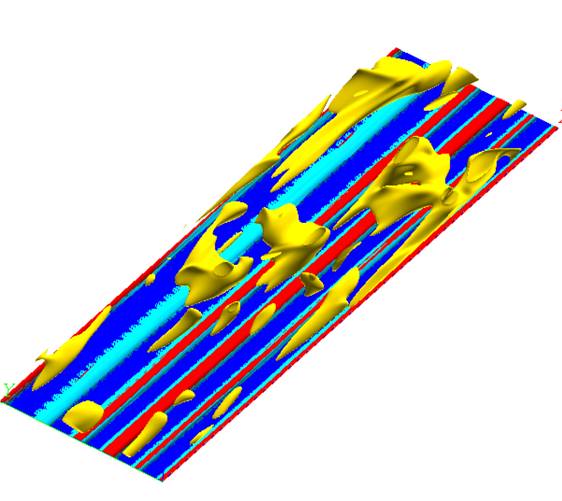
This talk will present an overview of our latest research results on polymer drag reduction based on multi-scale direct numerical simulations of polymer/solvent systems. The simulations target one of the experimental data points of Virk (1975) obtained in a turbulent pipe flow at a base (Newtonian) Ret≈225 (based on pipe radius and wall-friction velocity) using PEO of molecular weight 5.2x10⁶, with heterogeneity index of H=3.5, and concentration of c=30 wppm. A maximum drag reduction (MDR) of 73% was observed experimentally and is predicted by Virk's MDR asymptote. The computations were performed in a turbulent channel flow with a base Ret≈225 (based on channel half-width and wall-friction velocity) using realistic polymer parameters corresponding to the experimental conditions of Virk. The polymers were modeled using multi-mode bead-spring chain models derived from kinetic theory. Simulations were performed using a mixed Eulerian (for the hydrodynamics)/Lagrangian (for the polymer dynamics) formulation. Both stochastic (micro/macro) simulations, directly employing kinetic theory models of the polymer, as well as simulations based on constitutive models of the polymer, derived using closure approximations, have been performed. The full range of drag reduction, from low and moderate drag reduction to maximum drag reduction (~75%) is reproduced in the computations. In each case, the flow statistics are in quantitative agreement with experimental measurements at the same drag reduction. The physics of drag reduction in the databases generated by these simulations has been investigated. It is found that the polymer suppresses the turbulence through three different mechanisms; (i) opposing the motion of the near-wall vortical structures, (ii) preventing the formation of inflexional velocity profiles, and (iii) eliminating mean shear in the buffer layer by creating an effective slip at the wall. Once the turbulence is suppressed, the polymer prevents its regeneration by directly extracting energy from the mean flow, storing it as elastic energy, and dissipating it as viscous dissipation; thus bypassing the regular turbulent cascade of energy. Parametric studies have been performed to investigate the effect of polymer parameters on drag reduction. It is shown that polymer drag reduction is primarily a time-scale phenomenon. Maximum drag reduction requires a Weissenberg number, Wet=lut2/n in excess of 150, where l denotes the longest relaxation time of the polymer.
 GALCIT Home Page
|
|