Abstract-
Potential vorticity is the fundamental conserved
quantity in stratified flows. It plays a role analogous to that of vorticity in
unstratified flows, in particular as regards the importance of boundary effects.
For example, potential vorticity sheets can separate from a boundary in a manner
similar to that in which vorticity sheets separate from a boundary, except that
potential vorticity sheets at a boundary need not to be induced by friction ---
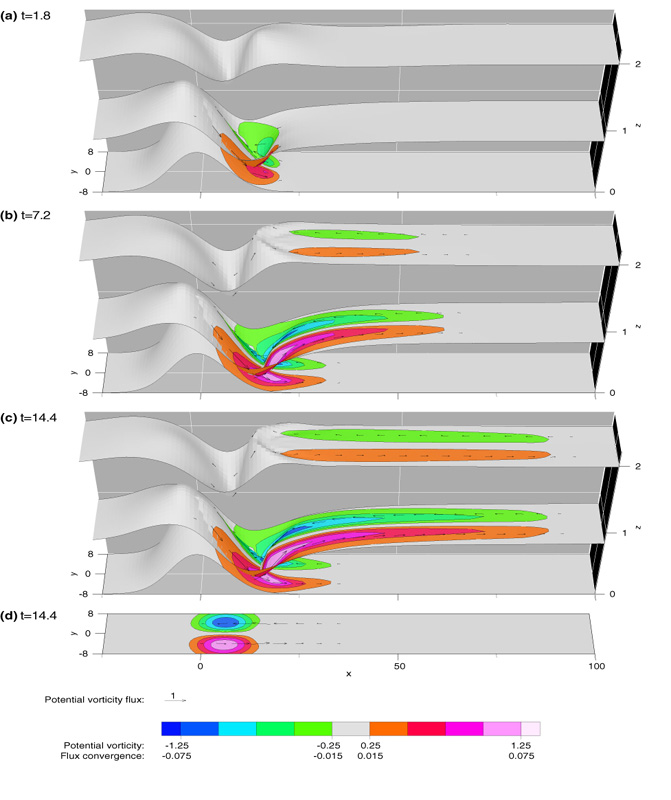
they can be induced by baroclinicity. Taking as point of departure a new
formulation of potential vorticity dynamics that encompasses boundary effects,
it is shown that the baroclinic induction of potential vorticity sheets and
their separation from a boundary can lead to the formation of lee vortices in
the wake of mountains, even when the boundary condition at the mountain surface
is a free-slip condition.
From the same formulation of potential vorticity dynamics, one can also derive exact balance conditions that the large-scale turbulence in the atmosphere must satisfy. These balance conditions differ fundamentally from similar balance conditions in quasigeostrophic theory, calling into question the adequacy of the quasigeostrophic approximation for theories of the global circulation of the atmosphere. Simulation results show self-similar behavior of atmospheric turbulence over a wide range of scales, with phase transitions between turbulent regimes that are of a fundamentally non-geostrophic nature.
 GALCIT Home Page
|
|