Abstract-
Richtmyer-Meshkov instability (RMI) occurs wherever a density gradient is
impulsively accelerated, e.g., by a shock wave. Misalignment between pressure
and density gradients leads to baroclinic production of vorticity, the latter
resulting in formation of vortical structures after the shock wave passage. The
vortex-dominated evolution of the flow eventually leads to turbulence. In the
process of RMI-induced transition to turbulence, several secondary instabilities
could develop in the flow, driven, e.g., by shear (Kelvin-Helmholtz) or by
density-pressure gradient misalignment (secondary baroclinic instability). The
exact nature of the secondary instabilities has been the subject of some
discussion in the literature, with different authors observing shear-induced and
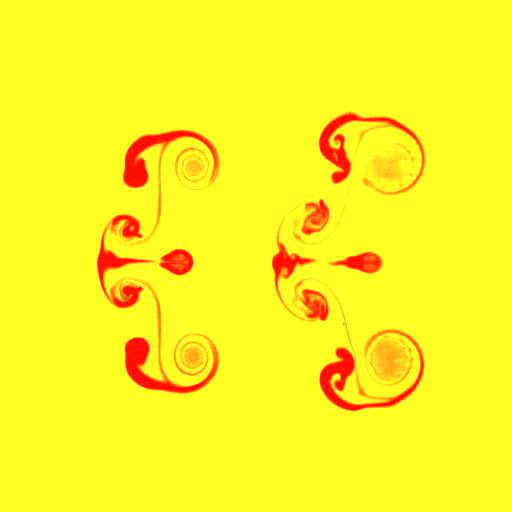
baroclinic secondary instabilities. An experimental study aiming to elucidate
the issue investigates a Mach 1.2 shock-accelerated column of heavy gas (sulfur
hexafluoride) immersed in lighter gas (air). Visualization and quantitative
analysis of the flow field is facilitated by planar laser-induced fluorescence
of acetone tracer pre-mixed with the heavy gas, which makes it possible to
resolve the small-scale (down to ~12 microns) structure of the flow.
Observations of the RMI-driven flow around the gas column show the presence of
two apparently distinct secondary instabilities: instability inside the vortex
cores as well as the instability along the outer edge of the primary vortex
spirals of heavy gas. The former is consistent with the reports of baroclinic
instability, while the latter is likely shear-induced.
 GALCIT Home Page
|
|