Abstract-
Secondary instabilities on the organized, spanwise, vortical
structures in incompressible shear layers, play an important role
in generating the onset of three dimensional turbulence in such flows.
The effect of increasing compressibility on these
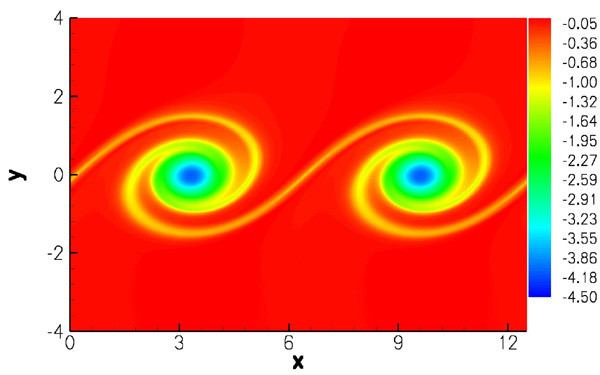
instabilities is examined by using the compressible Stuart vortex
as a model for a compressible shear layer.
The interaction of a shock with a compressible vortex may be viewed as a simplified model of the general interaction of a shock with the coherent structures in a turbulent flow field. An approximate theory for computing shock-compressible-vortex interactions is developed, based on Ribner (1954). The problem of convection of a frozen pattern of vorticity, dilatation, temperature and entropy through a planar shock wave is considered. The refraction and modification of the upstream disturbances into the three basis modes permitted by the linear Euler equations is derived, as well as the perturbation to the shock wave. This theory is used to compute approximate post-shock states corresponding to shock-CSV interactions, a model for shock shear layer interactions.
Finally, numerical solutions corresponding to a compressible analogue of the Mallier & Maslowe vortex (a periodic array of counter-rotating vortices) are presented. These solutions admit the existence of large regions of smooth supersonic flow, and could potentially be used to model the counter-rotating vortices arising from the single- and multi-mode Richtmyer-Meshkov instability.
 GALCIT Home Page
|
|